Medical Aesthetics for Anti-Aging · Device Comparison · Decision Guide
What’s the difference between Sofwave, Phoenix Radio, and SoundWave? Dcard debate: Is “one unit equals two units” true or false? Understand prices and drawbacks at a glance.
Short answer: Sofwave, Phoenix Radio Wave, and Ultrasound are three completely different anti-aging devices that utilize distinct energy sources. Ultrasound (focalized ultrasound) targets the SMAS fascia layer to achieve “deep lifting,” while Sofwave (synchronized parallel ultrasound beams) targets the dermal layer to provide “firming plus improved skin texture.” Phoenix Radio Wave (monopolar RF) delivers “volume heating for firming.” Claims that “one device replaces two” are mostly marketing tactics—no single device can currently simultaneously lift the fascia layer and heat the dermal layer effectively. This article uses a comparison table along with a decision checklist to help you choose the right option based on your level of skin laxity, budget, and tolerance for discomfort.
I. What exactly are the differences between the three types of devices? Let’s first understand the energy source.

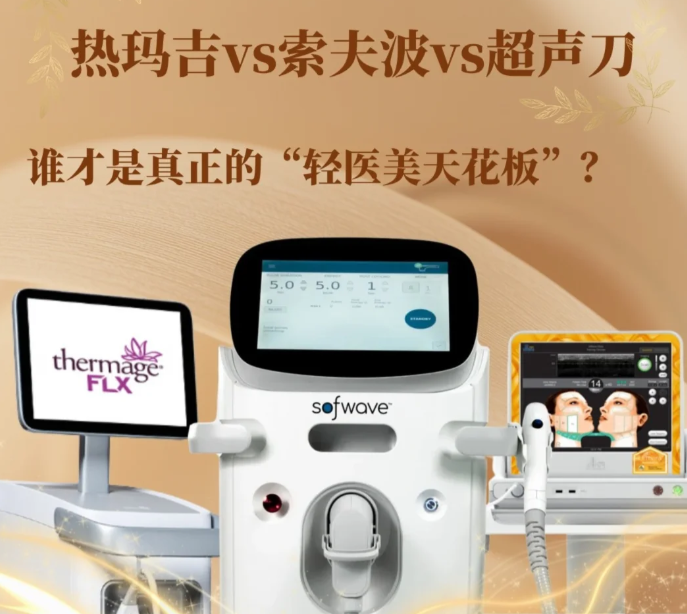
Image: Comparison of the appearances of three minimally invasive cosmetic devices—Thermage, Sofwave, and HIFU
What is Sofwave? It uses synchronized ultrasonic parallel beams to target the dermal layer.
💡 Key Takeaway
Sofwave utilizes Israel-developed SUPERB™ synchronized ultrasound technology. It employs 7 parallel ultrasound beams to treat the dermis layer (approximately 1.5mm thick) in just one session, while a surface cooling system helps protect the stratum corneum. This treatment is primarily designed to address fine lines, rough skin texture, and mild sagging, falling under the category of “shallow tightening + skin improvement.”
The procedure involves almost no needles or cuts, taking around 30–45 minutes per session. You can apply makeup and go out right after the treatment, with a very short recovery time. Since the energy is delivered to the dermis along with cooling effects, most people report minimal discomfort, making it a relatively gentle option for those who are sensitive to pain. Collagen regeneration takes time—results usually appear gradually over 3–12 weeks after the treatment, lasting approximately one year.

Image: Sofwave’s key advantages — non-invasive, trauma-free, with effects lasting 12 to 18 months
What is Phoenix Wave? Volume heating with monopolar RF
🔥 Key Takeaways
Phoenix RF belongs to the Monopolar RF category. Its mechanism involves using electrodes to heat the entire area from the dermis layer down to the subcutaneous fat layer in a “volume-based” manner, causing collagen to contract as a result of the heat and triggering subsequent regeneration. It is particularly effective for “tightening the skin texture + shaping facial contours,” offering noticeable improvements in Pores, skin texture, and mild sagging.
During the treatment, there is a noticeable warm sensation (the device usually comes equipped with a cooling head to reduce discomfort on the skin), which most people can tolerate. Those who are sensitive to heat can opt for anesthesia. Each session lasts around 40–60 minutes, with a short recovery period. Results gradually appear over 1–3 months and last for approximately a year. It operates on a different mechanism from ultrasound and Sofwave—using radiofrequency rather than ultrasonic waves.
What is HIFU? Focused ultrasound that targets the SMAS fascia layer directly.
💪 Key Takeaways
HIFU (also known as Ulthera or Ultherapy) utilizes focused ultrasound to deliver energy specifically to the SMAS fascia layer at approximately 4.5 mm depth (with 3.0 mm probes used for the dermal layer), enabling deep lifting from within. It is particularly suitable for those who suffer from noticeable sagging, dropped Apple Zone, or blurred jawlines.
Because the energy is delivered deep into the tissue and there’s no adjustable cooling mechanism, the pain associated with ultrasound treatment is relatively more noticeable among these three devices. Many people choose to apply an anesthetic or take painkillers before undergoing the treatment. The downtime is still short, but mild soreness and slight swelling may occur in the treated area in the days after the procedure. Results are typically visible within 2–3 months and last for about one to one and a half years.
II. Understand the key differences among the three at a glance
Energy Source, Action Level, and Suitable Population – A Comprehensive Comparison
📊 Side-by-side comparison of the three models
Note: The above represents a typical positioning at the theoretical level; actual results may vary depending on an individual’s age, degree of sagging, and treatment parameters.
Three major advantages and three major disadvantages — explained all at once
⚖️ Pros vs Cons
III. Is “One unit replaces two” true? Dcard’s in-depth analysis
Why do some people say that “one Sofwave is equivalent to two devices that combine radio waves and ultrasound”?
🔍 Source of the quote
On communities like Dcard and Threads, you often see claims that “one Sofwave device can replace both ultrasound and radiofrequency treatments.” Behind this are competitive marketing tactics by manufacturers and clinics: Sofwave uses ultrasound to target the dermis and emphasizes the “ultrasound + synchronization” concept, positioning it as a solution that delivers lifting and tightening effects in just one treatment. Some user reviews do indeed mention improved skin quality and tighter facial contours after using it, which has led to the idea of “getting the equivalent of two devices for the price” spreading increasingly widely.
Truth: No device can simultaneously perform deep lifting and volumizing heating.
⚠️ Honest Verdict
The functional levels and energy mechanisms of these three types of devices differ fundamentally: ultrasound targets the 4.5mm fascia layer, Sofwave targets the 1.5mm dermal layer, while radio waves utilize volumetric RF heating. No single device can effectively achieve both “deep fascial lifting” and “dermal volumetric heating” in one unit—this is a physical limitation that cannot be overcome simply by swapping out the probe.
So, “one device replaces two” is more of a marketing slogan. For those who are only slightly aged or have mild sagging, Sofwave or radio frequency therapy alone may be sufficient. But for those with noticeable sagging, superficial tightening often isn’t enough to address it—deeper lifting using ultrasound technology or a combination of both is required. You should choose the right device based on your degree of sagging, rather than being swayed by the phrase “replaces two.”
IV. Understand Prices at a Glance (Market Reference Prices)

Image: Reference for common hair count combinations at Sofwave (subject to the clinic’s quoted price)
Reference price for full-face treatment with three devices
💰 Price Range
The following are common reference ranges for the Taiwan market. Actual prices can vary significantly depending on the clinic, number of units implanted, treatment area, and any ongoing promotions—please refer to the quote given on-site.
How to buy without running into pitfalls
🎯 Buying Tips
① Check the number of hairs/fibers, not just the total price: Lower-priced full-face treatments may have a reduced number of hairs used, resulting in less effective outcomes—make sure to confirm the coverage before placing an order.
② Verify that the instruments and probes are genuine: Inspect the probe packaging or scan the QR code on site to ensure that only original, unused consumables are used.
③ Don’t let “treat two devices at once” set the pace: Choose based on your level of sagging—don’t expect superficial devices to solve severe sagging in just one session.
④ Ask about post-treatment care and maintenance: Clarify the interval between follow-up treatments and whether post-op recovery services are included before making payment.
V. Who Should Choose Which? A Matching Checklist
Choose based on the level of relaxation and your needs
👩 Quick Decision-Making Match
Who should avoid getting ultrasound treatment first?

Image: Before-and-after comparison of Sofwave treatment (10 days after completion)
🚫 Target Audience Note
Pregnant women, those who are breastfeeding, or individuals with active infections on their face or implanted electronic devices should first undergo a medical evaluation. Those who are extremely sensitive to pain and reluctant to use anesthetic creams can start by trying Sofwave or radiofrequency therapy. It’s recommended that any treatment be performed by a qualified physician after a face-to-face consultation, rather than making a purchase based solely on price.
VI. Frequently Asked Questions FAQ
Q: Can all three be done at the same time?
A: It’s not recommended to combine these treatments on the same day. Reason: Using both focused ultrasound and radiofrequency energy together increases the risk of localized overheating and swelling, so most clinics schedule them as separate treatments.
Q: How is the pain level ranked?
A: Ultrasound > Radio waves > Sofwave. Reason: Ultrasound delivers energy deep into the skin without adjustable cooling, and pain levels are relatively noticeable according to various user experience reviews and feedback.
Q: How long does the effect last?
A: Around 12 months. Reason: All three types stimulate collagen regeneration, with a collagen turnover cycle of about one year; actual duration varies depending on age and post-surgery care.
Q: Is “one unit equals two units” true?
A: No. Reason: The three work at different levels and through different mechanisms, so a single device cannot simultaneously lift the SMAS fascia layer and heat the dermal layer to increase volume (per the manufacturer’s technical explanation).
Q: Which one should I choose if my budget is limited?
A: First, assess the degree of sagging. Guideline: For early signs of aging, opt for Sofwave or radiofrequency; for noticeable sagging, choose ultrasound therapy. Prioritize your needs over just price.
References
- Original principle explanation of Sofwave (SUPERB™ synchronized ultrasound technology, Sofcool™ epidermal cooling)
- Public information on the HIFU wavelength targeted by Ulthera/Ultherapy for the SMAS layer
- Literature on the volumetric heating mechanism of monopolar RF and collagen regeneration
- Public pricing from various cosmetic clinics in Taiwan and user experience shares on Dcard/Threads (price range summary)
Disclaimer: This article is for educational purposes and decision-making reference only, and does not constitute medical advice. Please consult a qualified physician for an in-person assessment of your specific treatment needs. Prices are subject to the final quote provided at the clinic.

Scan the code to add Hannah972 · One-on-one Chinese support for South Korea’s cosmetic surgery industry
Or
💬 Book via WeChat: H
annah972
Chinese customer service responds instantly
💬 Book via WeChat: H
annah972
Chinese customer service responds instantly