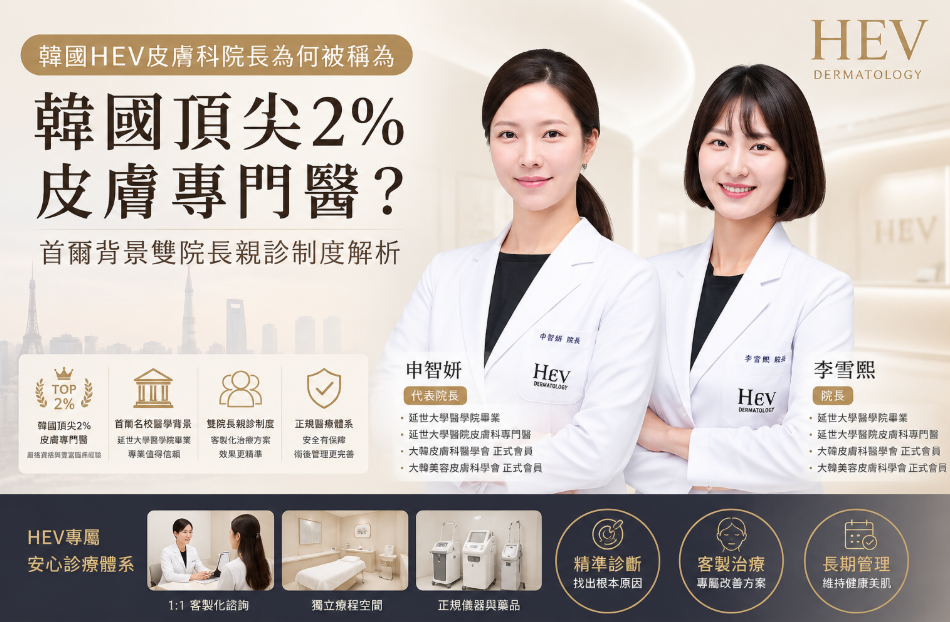
💉 Qualifications of the Dean of the HEV Dermatology Academy in South Korea: Why is he considered to belong to the “top 2% in South Korea”?
To be honest, after working in the medical aesthetics industry in South Korea for so long, it was the first time I had heard someone refer to the directors of a Dermatology clinic as belonging to “the top 2% in South Korea.” I was really taken aback. In South Korea, there are countless doctors with the title of “specialist,” but those who can truly be considered at the top of their field actually make up no more than 2%. The two directors of the Sinsa branch of HEV CLINIC in South Korea are precisely among this 2% elite group.
The classification of medical qualifications in South Korea is extremely strict. To become a “Dermatologist” (피부과 전문의), one must first pass the South Korean medical licensing examination, then undergo specialized dermatology training and pass a national examination. In South Korea, approximately 5% of all physicians hold this qualification, and among those, only a small number are recognized by their peers as “top-tier” professionals in clinical practice.
The two directors of the Sinsa branch of South Korea’s HEV Dermatology not only hold professional qualifications in Dermatology but also possess many years of experience in managing large-scale dermatology clinics in Gangnam, Seoul’s affluent area. The highly competitive dermatology industry in Gangnam makes it a true testament to their expertise that they have been able to establish themselves in this region and gain the trust of their patients.
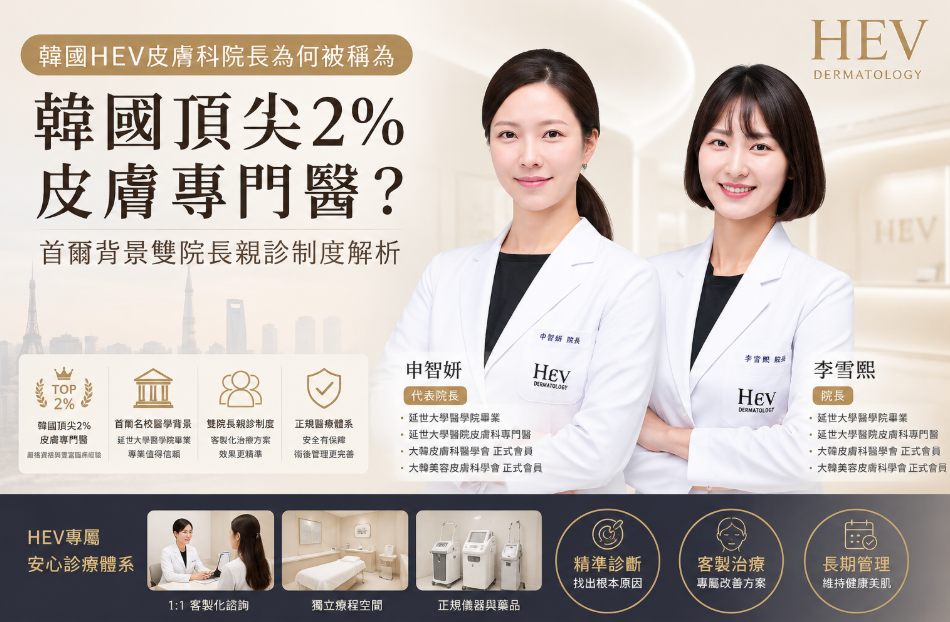
🏥 South Korea’s HEV Dermatology offers a system where both directors personally conduct the entire treatment process. All consultations are carried out by specialized physicians.
The system of having two directors is not common in Dermatology clinics in South Korea. In most clinics that operate under a “director system,” there is actually only one nominal director, while the actual diagnosis and treatment are usually carried out by ordinary physicians or nurses. However, the Sinsa branch of HEV Dermatology in South Korea implements a true system where both directors personally handle all aspects of patient care – from initial consultations and treatment plan formulation to the actual procedures. Both directors possess official qualifications in Dermatology.
The advantage of this system is that every patient who visits a Dermatology clinic in South Korea can be assured that their treatment will be carried out by a chief physician who has received formal specialized training, rather than by a technician working on an assembly line. I have friends who have visited clinics with such a “nominal chief physician system”; in those cases, the entire treatment process was performed solely by nurses, while the chief physician merely said a few words before leaving. To be honest, that feeling is somewhat akin to being treated as a lab subject.
The dual-director system at the Sinsa branch of South Korea’s HEV Dermatology means that…
- During the initial consultation, one of the directors will conduct a thorough skin examination and assess your needs.
- The treatment plan is jointly determined by the two directors to ensure maximum effectiveness.
- For treatments with high technical requirements such as HIFU and injections, the hospital director personally performs the procedures.
- Postoperative follow-up is the responsibility of the chief physician who performed the procedure, as they are the most knowledgeable about the patient’s postoperative condition.
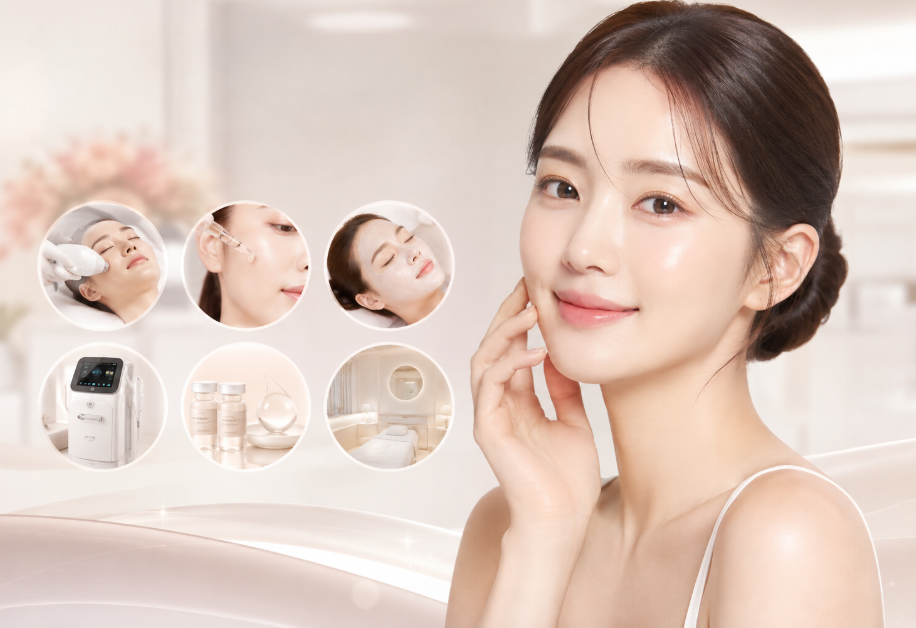
📊 What are the evaluation criteria for the top 2% of dermatologists in South Korea?
So, what kind of Dermatology department head can be considered to belong to the “top 2%”? According to the standards of South Korea’s medical aesthetics industry, there are mainly the following criteria:
- Professional qualification certification: It is required to hold the title of “Dermatology Specialist” certified by the South Korean Dermatology Society, as well as have a record of ongoing professional development. In South Korea, obtaining the title of specialist requires many years of specialized training; it is not possible to apply for this title simply by graduating from an ordinary medical school.
- Length of clinical experience: The actual clinical experience in performing procedures (rather than merely theoretical knowledge) must be more than 10 years, involving a wide range of case types. The practitioner should have accumulated experience in dealing with various skin issues such as pigmentation, wrinkles, scars, and rosacea.
- Instrument operation qualifications: For advanced devices such as the HIFU and Juvelook, it is necessary to hold an official certification obtained through training provided by the manufacturer, and this certification must be updated regularly. Although operating these instruments may seem simple, even slight differences in energy intensity, angle, or application duration can significantly affect the treatment outcome.
- Academic and professional status: Some of the most renowned directors are invited to give lectures at industry seminars, where they share the latest treatment technologies. This very fact that they are invited by their peers to teach is in itself a symbol of recognition within the industry.
- Customer satisfaction and repeat business rate: The proportion of long-term repeat customers and post-treatment satisfaction are used as reference indicators.
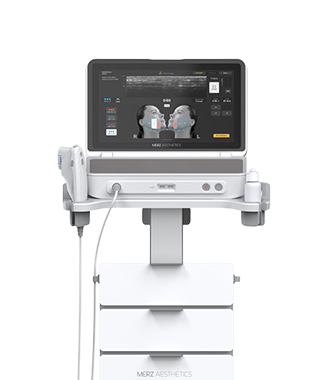
The two directors of the Sinsa branch of HEV Dermatology in South Korea have met the high industry standards in all of the aforementioned criteria. In fact, one of the directors is among the few physicians in South Korea who possess the training qualifications to operate the “second-generation HIFU device” – only approximately 10 physicians in the entire country hold this level of certification.
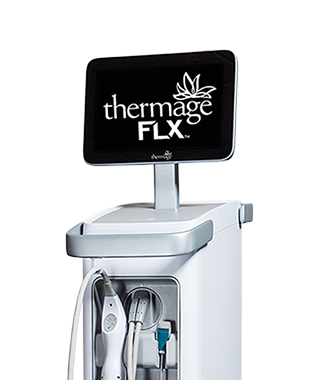
🔬 What does obtaining the certification to operate the second-generation HIFU device at South Korea’s HEV Dermatology mean?
As mentioned earlier, one of the directors of HEV Dermatology in South Korea holds the certification to teach the operation of the HIFU Second Generation device. The value of this certification is likely much higher than many customers might imagine.
HIFU has been widely used in the South Korea medical aesthetics market for many years, yet there is a significant variation in the technical skills of those who operate it. Most practitioners in these clinics have only received basic training provided by the equipment manufacturers and are capable of performing standard procedures independently. However, having the “qualification to teach operation techniques” indicates that a doctor not only possesses advanced skills but also has the ability to train other doctors on the correct use of this technology – this represents the highest level of recognition granted by the equipment manufacturers for a doctor’s technical competence.
In entire South Korea, there are only about 10 doctors who possess the qualifications to teach the operation of the second-generation HIFU device. Choosing to receive treatment under the expertise of such scarce specialists certainly provides a greater sense of reassurance. The control of the energy output of the HIFU device is a technical matter – too high an energy level may cause burns, while too low an energy level will render the treatment ineffective. When applying the device to bony areas or soft tissues, different levels of intensity and duration are required. Only true experts are able to master these details and apply them perfectly.
✨ What does it mean to be an officially certified hospital by Juvelook, a Dermatology clinic in South Korea?
Juvelook (쥬베르룩) is a well-known Collagen injection brand in South Korea, and together with Rejuran, it represents the two most popular hyaluronic acid injection series in the country. Juvelook primarily uses PDLLA as its active ingredient, which stimulates the regeneration of Collagen and achieves lasting improvement results.
Juvelook officially grants the title of “Certified Hospital” only to clinics that use genuine products and whose staff have received proper training. South Korea’s HEV Dermatology holds this certification, which signifies that…
- The Juvelook products used are genuine original products; counterfeit versions that cause blockages are not used.
- The doctor has received training in the original injection techniques of Juvelook.
- Complies with Juvelook’s official requirements regarding medical environments and service quality.
In South Korea’s medical aesthetics market, there are some clinics that use injections of unknown origin. Choosing a hospital with official certification can significantly reduce the risks involved.
📋 Who is suitable and who is not suitable for visiting a Dermatology clinic in South Korea for HEV treatments?
✅ Target audience:
- Customers who pursue top-notch technology: If you have high requirements regarding the qualifications of physicians and do not want to be treated as just another customer in a mass production process, the system at South Korea’s HEV Dermatology, where both directors personally conduct consultations, can meet your needs.
- For customers who require HIFU treatment or Juvelook procedures: This hospital is an officially authorized Juvelook treatment center, and its director holds the certification to operate the second-generation HIFU equipment, ensuring the quality of these medical treatments.
- White-collar workers working in Gangnam or Chinese residents living in Seoul: It is only a 3-minute walk from Exit 4 of Sinsa Station on Line 3 of the subway. The location is conveniently accessible, and the business hours extend until 8 p.m., making it very convenient to visit after work.
- For customers in need of “moderate treatment”: Unlike some clinics that simply focus on increasing the price of their packages, South Korea’s HEV Dermatology provides “moderate treatment” based on the actual needs of each customer, and recommends appropriate treatment plans accordingly.
- For customers with long-term anti-aging needs: The dual-director system ensures that each treatment is monitored by the same director, allowing for consistent record-keeping and more accurate evaluation of treatment results.
❌ Groups not recommended to visit:
- Short-term visitors who intend to stay in South Korea for a short period of time (it is recommended that patients undergoing laser freckle removal treatments stay for at least 3 months; otherwise, the results may not be significant)
- Customers who prefer an ultra-fast pace and seek streamlined services that allow them to “arrive today and leave today”
- Customers who are extremely sensitive to prices and only want to choose the cheapest option (since this clinic targets the mid-to-high-end market)
❓ Frequently Asked Questions
Q: At Dermatology clinics in South Korea, is it possible to request a specific chief physician for consultation?
A: Yes. The clinic operates on a reservation system. Customers can indicate their preference for a specific director when making a reservation, and the clinic will try to accommodate this request based on the director’s schedule. However, if the director is on vacation or all reservations are full, the client will be informed in advance and alternative options will be provided.
Q: Is the price for a consultation with both directors more expensive than that at an ordinary clinic?
A: Not necessarily. Some of the services offered by this clinic are priced on par with those at similar institutions in Gangnam, but the added value of having treatments performed personally by the clinic director lies in the fact that these treatments are carried out by specialists with extensive clinical experience, thus ensuring a higher level of technical expertise. For specific prices, it is recommended to consult BeautsGO for the latest information.
Q: What should I bring with me when visiting seoulcheil Dermatology in South Korea for the first time?
A: It is recommended to bring the following: passport (for foreigners serving as proof of identification for medical treatment), records of previous treatments received at other clinics (if any), and a description of the desired changes you wish to achieve. This clinic provides support in Chinese, so there is no need to worry too much about language barriers even for first-time visits.
Q: What does it mean for a hospital to be certified by Juvelook?
A: Juvelook is a well-known Collagen injection brand in South Korea. The official authorities only grant the status of “Certified Hospital” to those clinics that use genuine products and whose staff have received proper training. South Korea’s HEV Dermatology clinic holds this certification, which indicates that the Juvelook products used by them are genuine and that the injection techniques employed are correct.
Q: What are the differences between the second-generation HIFU and ordinary HIFU devices?
A: The second-generation HIFU has seen improvements in terms of the precision of energy delivery, probe design, and pain control. Directors who have received training in its operation can more accurately control the depth and scope of energy application, thereby reducing postoperative discomfort and enhancing the effectiveness of the treatment.