
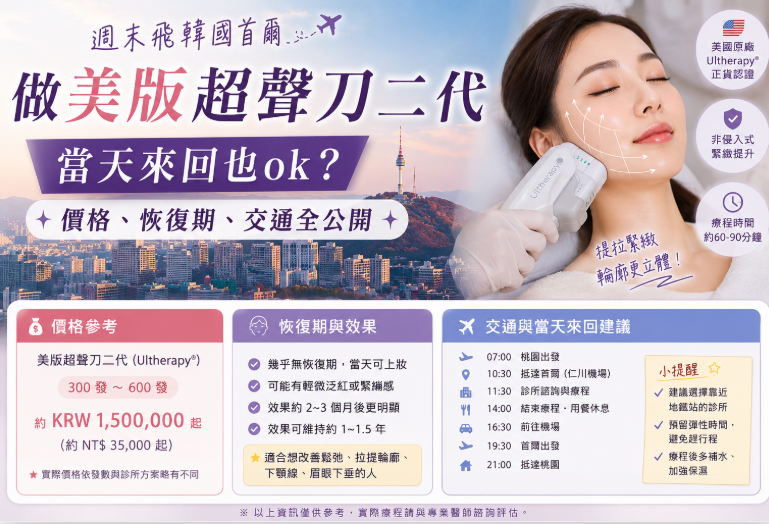
To be honest, every time I see the price lists for medical beauty treatments in South Korea, I think it’s actually more cost-effective to fly there than to stay home. Especially for the second-generation Ulthrea – in Taiwan, the price usually starts from 60,000 to 80,000 Taiwanese dollars. But if you fly to Seoul for a full-face treatment, the cost can be reduced by half, and you still get some money back. After the treatment, you can go shopping and eat barbecue on the same day, and then fly home the next day without even needing to take a day off from work.
This article provides an overview of the latest market trends for the second-generation Ulthrea in South Korea, recommends 10 Seoul clinics where appointments can be made directly (along with BeautsGO certification information and price comparisons), and offers practical guidance for weekend treatments—including how to get there, the recovery time, who is suitable for the procedure, and who should avoid it. It’s recommended to save this article and refer to it before you travel.
What is the second-generation Ulthrea? How does it differ from the first generation and the Korean version?
💡
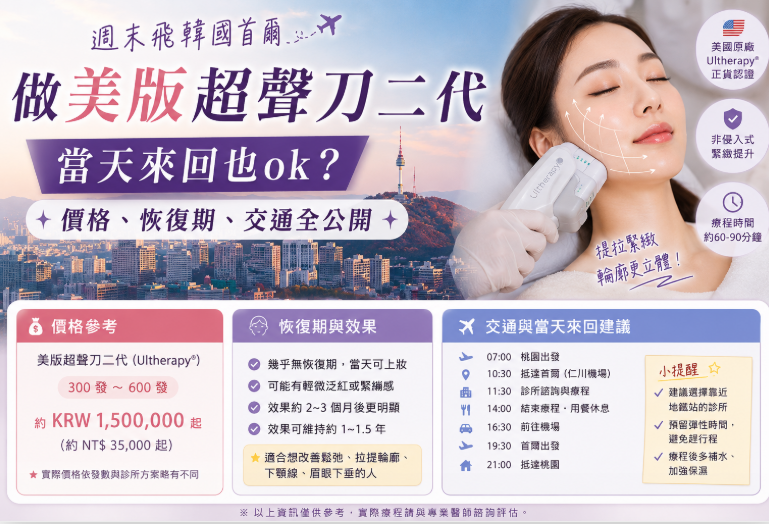
The Ulthrea, developed by the American company Merz, is a non-invasive lifting device that uses high-intensity focused HIFU to precisely heat the SMAS layer deep within the skin, stimulating the contraction and regeneration of Collagen and thereby achieving a tightening and lifting effect on the entire face. The second-generation model, Ultherapy Prime, launched in 2025, features improved stability in energy delivery and a more advanced cooling system, resulting in significantly less discomfort during treatment compared to the first generation.
Many people ask, “So what’s the difference between it and the Korean version of the Ulthrea?” The most crucial differences lie in three areas: First, the American version is a medical device approved by the FDA, and its accuracy and safety have been proven through years of clinical trials. Second, the real-time imaging system of the American version allows doctors to “see” the location of the fascia layer beneath the skin, ensuring that the energy is delivered at the correct depth – unlike the Korean version or other HIFU devices, which can only operate in a “blind” manner. Third, the effects of the American version last longer, typically ranging from 1 to 2 years. If you seek stable results and are unwilling to take risks, the second-generation American version of the Ulthrea is currently the benchmark for such devices.
Market trends of the second-generation Ulthrea in South Korea | Prices for 300 and 600 treatments are fully disclosed
💰
Regarding the market situation of the second-generation Ulthrea in South Korea in 2026, based on actual surveys conducted in over 50 clinics in Gangnam District, Seoul, the price range is approximately as follows:
- Full face + neck (600-800 hairs): ¥680,000-1,080,000 (approximately NT$15,000-24,000)
- Full face treatment (excluding the neck area), with 300-500 hairs implanted: ¥4.1-8.9 million (approximately NT$9,000-20,000)
- Lower half of the face + chin area (200-300 hairs): ¥927,000 to ¥610,000 (approximately NT$6,000 to NT$13,500)
- Eyebrow arch/eyeball area (100-200 hairs): ¥4.2 million to ¥4.7 million (approximately NT$4,500 to NT$10,500)
Chain clinics often offer promotional prices: 300 treatments can cost as little as ₩890,000 (Toxnfill Gangnam Main Store, April promotion), while 600 treatments are around ₩1.79 million. High-end clinics charge over ₩1 million, but they offer personalized consultations, a more comfortable environment, and better pain management options, making them suitable for those with higher quality requirements. It’s also important to note that since 2026, South Korea has abolished the 10% VAT refund for foreign patients. Previously, patients could get a refund of approximately ₩150,000, but this benefit is no longer available. Remember to take this into account when planning your budget.
Compared with the prices in Taiwan – where a full-face treatment with the Ulthrea HIFU costs anywhere from NT$60,000 to NT$80,000 – flying to South Korea for a full-face treatment, including airfare and one night’s accommodation, might actually be cheaper than having the procedure done in Taiwan. This is also why more and more people are taking a weekend trip to Seoul to enjoy themselves while getting better-looking at the same time.
Top 10 Recommended Clinics in Seoul That Use the Second Generation of Ulthrea | Prices and Reviews at a Glance
🏥
The following 10 clinics are all South Korean Dermatology practices certified by BeautsGO and available for Chinese-language reservations. They are located in popular cosmetic treatment areas such as Gangnam, Cheongdam, Myeongdong, Hongdae, and Dongdaemun. Each clinic comes with its own unique UTM card and detailed price information; you can simply click on the card to schedule a consultation or check prices.
Gangnam Sinsa District | Three High-Quality Anti-Aging Specialty Clinics
👑
① HeeXi HEV Dermatology: Ulthrea Generation 2 Starting from ₩545,000 Located in Sinsa-dong, HeeXi is one of
the clinics confirmed to have genuine Ulthrea Generation 2 equipment in this round of price comparisons. The entry price of ₩545,000 is highly competitive among high-end clinics. They also offer treatments such as Shuyan Cui DongAn Center Introduction and Juvelook, which are based on Collagen enhancement techniques and are ideal for those who want to achieve both lifting and Collagen replenishment in one go. The clinic is just a 3-minute walk from Sinsa Station, so you can enjoy a stroll along the tree-lined avenue right after your treatment.

② Barog Hospital (Gangnam Branch): Onda + ultrasound package starting from ₩490,000. Barog is a established large-sca
le hospital in Gangnam District, known for its personalized consultations conducted by the hospital director rather than a standardized treatment process. Their Onda 40k + Korean-style ultrasound 300-shot package for ₩490,000 is an excellent option for those with limited budgets but still interested in trying HIFU treatments. Although it isn’t the Ulthrea, it represents a safe and affordable entry-point for newcomers looking to experience the effects of HIFU. The hospital is located just 3 minutes away on foot from Exit 11 of Gangnam Station.

③ Lumiin Dermatology: High-quality HIFU + collagen regeneration treatment.
Located near Dazhi Station in Gangnam, Lumiin specializes in the REVIVE long-lasting HIFU treatment and the JUVELOOK collagen enhancement therapy, which are particularly suitable as post-treatment care after HIFU procedures. They focus on providing premium services, and their director takes great care in conducting personal consultations—nothing short of thorough and patient. If you have undergone HIFU at another clinic and are looking for follow-up care, Lumiin is an excellent option.
Cheongdam District | Two professional HIFU clinics
🪄
④ Cheongdam Minit Dermatology: Ulthrea starts from ₩450,000. Cheongdam Minit is considered
a high-value option in Cheongdam-dong. The Ulthrea treatment costs ₩450,000 and is also accompanied by hyperbaric oxygen therapy to accelerate post-treatment recovery. Although the clinic is small, it is well-equipped, and many locals also come here for cosmetic treatments. It is only a 5-minute walk from Apgujeong Roda Station, and Cheongdam Fashion Street is right next door.

⑤ Cheongdam IT’S ME Dermatology: Second-generation HIFU with 300 treatment sessions, LED light therapy + oxygen management system – only ₩900,000. IT’S ME offers what seems to be the “most comprehensive
package” available right now: second-generation HIFU with 300 treatment sessions, free of charge along with LED light therapy and oxygen management system to assist in post-treatment recovery. At a price of ₩900,000, this package is truly competitive considering the use of second-generation equipment. The director has a deep understanding of the facial structure of Asians and is particularly skilled at making precise adjustments to the jawline and Apple Zone. The clinic is located just 8 minutes away on foot from Cheongdam Station.

Myeongdong District | The popular destination for shopping and beauty treatments
🧳
⑥ DAN-A Dermatology in Myeongdong: Located right next to the main street
in Myeongdong, this clinic is in the very heart of the shopping district, making it convenient to go shopping immediately after treatment. They are renowned for their LDM radiofrequency and Collagen enhancement treatments. Although the specific prices of HIFU treatments need to be checked directly on BeautsGO, the clinic has received high overall ratings. Many posts on Dcard sharing Korean beauty treatments mention that DAN-A provides friendly service without any aggressive sales tactics. It is only a 3-minute walk from Exit 6 of Myeongdong Station.

⑦ Lijin Dermatology in Myeongdong: HIFU + Lipolysis Needle Package for ₩1.39 million. Lijin’s ONDA device combin
ed with the first-generation Ulthrea HIFU system (300 treatments) and Lijin’s lipolysis needle package is ideal for those who wish to achieve “lifting effects and more defined contours” in one treatment. Although it isn’t the second-generation model, the first-generation Ulthrea still delivers excellent results. Together with the benefits of ONDA and lipolysis needles, the facial contours will be improved more significantly than if only HIFU were used alone. The clinic is located at Exit 5 of Myeongdong Station, making it very convenient to access.
Hongdae District | The favorite destination for young people seeking minor cosmetic treatments
🌊
⑧ Hongdae LOVAÉ Dermatology: The American-style second-generation HIFU device is available starting from 400,000 won.
LOVAÉ has the “lowest price for the American-style second-generation HIFU device” among all the institutions surveyed. The entry-level price of 400,000 won makes it very suitable for those who are considering trying HIFU for the first time. In addition, they also offer a package that combines eye treatment with Rejuran; those who want to address signs of aging around the eyes can get both treatments done at the same place. It takes only 7 minutes to walk from the Hongdae entrance station, and there are numerous cafes and small shops in the surrounding area.

⑨ Hongdae Kate Dermatology: High-value basic skincare services. Kate is
an affordable and popular clinic in the Hongdae area. The prices for Juvelook Black Bottle are ₩88,000, and LDM is also ₩88,000 – these prices are incredibly competitive. Although their main focus is on basic hydration treatments and skin management, the specific fees for HIFU treatments need to be confirmed through BeautsGO. However, if your primary needs are post-treatment care or regular skin maintenance, Kate is definitely the top choice in Hongdae.

Dongdaemun District | High-end beauty treatments hidden away by locals
📌
⑩ Dongdaemun Doctors Dermatology: Density Lifting Treatment with Amazing Results
Doctors’ “Den
sity Lifting” treatment, priced at ₩990,000, is their flagship service. It offers non-surgical full-face tightening effects that complement those achieved by HIFU. Their Skinvive treatments are also very popular; combining the Density Lifting treatment with Skinvive results in a significantly more plump and firm appearance. The clinic is located just a 5-minute walk from Dongdaemun Historical and Cultural Park Station.

Practical tips for a weekend trip: Catch the earliest flight and go shopping right after your arrival.
🧳
The following is the actual weekend itinerary I followed myself: from getting off the plane to undergoing the HIFU treatment and then going shopping and eating barbecue, there was definitely enough time.
- Saturday, 06:30 departure from Taoyuan/Songshan → 09:00 arrival in Incheon/Gimpo: Take the early morning flight. The time difference between Seoul and Taiwan is 1 hour, so the actual flight time is approximately 2.5 hours. Gimpo Airport is located closer to the downtown area of Seoul, so it would be preferable to use Gimpo for arrivals and departures if possible.
- 10:00 Arrival at the airport + take the airport express train to Seoul Station (about 45 minutes): The airport express train goes directly to Seoul Station, costing ₩9,500 – which is much cheaper than taking a taxi. Upon arriving at Seoul Station, transfer to the subway to get to the clinic.
- Arrive at the clinic at 11:00 → Consultation + Anesthesia application: It is recommended to schedule an appointment for 11 a.m. The consultation itself will take approximately 15 minutes, and the application of the anesthesia cream will take another 30 minutes. During this time, the doctor will assess the condition of your skin and determine the exact area to be treated.
- The HIFU treatment begins at 12:00 and lasts approximately 45 to 90 minutes. Depending on the number of treatments performed, 300 treatments take around 45 minutes, while 600 treatments take about 90 minutes. The pain level is roughly on the scale of 5 to 7 (with the pain being most noticeable along the jawline and on the Forehead); however, the upgraded second-generation cooling system has made the procedure much more comfortable compared to the first generation.
- 13:30 Post-treatment rest + ice application (about 30 minutes): After the treatment, your face may turn slightly red, but after about 30 minutes of ice application, the redness will mostly subside, and you can apply makeup directly afterward.
- Start shopping and eating barbecue at 14:00! There is no recovery period needed; you can resume your normal activities immediately after the treatment. You can shop around in Myeongdong, Hongdae, or Gangnam whenever you like.
- On Sunday, you can take the afternoon flight back to Taiwan. If you don’t want to rush too much, you could also stay overnight after finishing your activities on Saturday, and then go to a steam room on Sunday morning to relax before boarding the plane.
If you live in Taipei, Taichung, or Kaohsiung, it’s basically possible to complete the trip by taking an early morning flight and returning in the evening, thus finishing it in just one day. However, if you prefer a more relaxed experience, it’s recommended to go on Saturday and return on Sunday – this way, you can also take a stroll in Hanjiang Park or enjoy some Korean barbecue.
Recovery Period and Post-Surgery Precautions | Is it really possible to go shopping right after the procedure?
⚠️
That’s true. One of the greatest advantages of HIFU is its virtually zero recovery period. After the procedure, the face may turn slightly red and feel a mild burning sensation, but these effects will subside after applying ice for 30 minutes, making them almost invisible to others. Here is the complete post-procedure timeline:
- On the day after the procedure: The face may appear slightly red and swollen, but makeup can be applied after applying ice packs. It is safe to go shopping, eat meals, or take flights as usual.
- 1–3 days after the procedure: There may be a slight dull pain when touching the area where the injection was administered, similar to muscle soreness after exercise, but it does not affect daily activities.
- 1–2 weeks after the procedure: The discomfort and tenderness completely disappear, and the skin begins to feel firmer to the touch.
- 1–2 months after the procedure: Collagen begins to proliferate, causing the skin to become slightly tighter – you will notice this change yourself.
- 3–6 months after the procedure: The results reach their peak! The jawline becomes much more defined, and the facial contours appear more IPCHEA. Friends will start asking you if you’ve lost weight.
- Effect duration: Approximately 1-2 years; it is recommended to perform maintenance once a year.
Postoperative precautions:
- Avoid high-temperature environments for 1 week: Do not visit hot springs, saunas, or steam rooms, as high temperatures can accelerate metabolism and interfere with the production of Collagen.
- Sun protection is essential: After the procedure, the skin becomes more sensitive to ultraviolet rays, so it is necessary to apply sunscreen with an SPF of 50+.
- Drink plenty of water: Consume at least 2000 centum core of water daily, as the production of Collagen requires adequate hydration.
- Avoid exfoliating or using acidic treatments for 1 week: After the procedure, the skin is quite fragile, so refrain from using irritating products such as alpha hydroxy acids or fruit acids.
- Do not perform facial massages within 2 weeks after the procedure to prevent external forces from interfering with the rearrangement of Collagen.
People who are suitable vs those who are not suitable for the second-generation Ulthrea treatment
👭
✅ Suitable for:
- People who experience mild to moderate facial sagging or blurred jawlines (the effects are most noticeable for those aged 30-50).
- Those who are reluctant to undergo surgery due to concerns about its risks but still desire noticeable lifting results
- For those with limited budgets who want to purchase high-quality medical devices at more affordable prices in South Korea
- For those who are too busy with work and don’t want to wait for a recovery period – they can return to work and social activities immediately after the procedure.
- Those who have already undergone the first-generation HIFU treatment and wish to upgrade to the second generation for a less painful experience
❌ Not suitable for:
- If the degree of facial sagging is severe (to the point where facelift surgery is necessary), the effectiveness of HIFU will be limited; it is recommended to consult a doctor about facelift surgery.
- Pregnant or breastfeeding
- Those with a tendency to develop keloidal scars or severe Scar tissue problems
- If there are open wounds, infections, or severe acne at the injection site
- If you have metal implants on your face, such as unabsorbed sutures or steel pins, you should inform your doctor before the procedure so that they can assess the situation.
Frequently Asked Questions
📱
Q: What are the differences between the second-generation Ulthrea and Thermage FLX? A: Both are non-invasive lifting treatments, but their
mechanisms work differently. The HIFU uses ultrasonic waves to target the SMAS layer (the deepest layer of the skin), while Thermage FLX uses radiofrequency to heat the dermis (the middle layer). In simple terms, the HIFU lifts from the deeper layers, while Thermage FLX tightens the skin from the middle layer. Many people choose to combine both treatments for complementary effects. For those over 35 years old, it is recommended to start with the HIFU as a foundation treatment and then follow up with Thermage FLX for additional surface tightening.
Q: Is the second-generation Ulthrea painful? A: The pain lev
el has decreased significantly since the upgrade of the cooling system in the second generation. The pain ranges from 5 to 7 on a scale of 10; it is most noticeable near the jawline and on the Forehead, but overall, it remains within an acceptable range. Applying numbing cream for 30 minutes, combined with the cooling system of the second-generation device, allows most people to complete the treatment without discomfort. If you are particularly concerned about pain, some clinics offer sedation services (at an additional cost of ¥70,000 to ¥200,000).
Q: Can I take a flight right after having the HIFU treatment? A: Definitel
y! There is no recovery period after the HIFU treatment. The slight redness that appears immediately will disappear within 30 minutes, so it will not affect your ability to fly at all. My friend went straight to Incheon Airport after the treatment and took the afternoon flight back to Taipei without any problems.
Q: How can I ensure that the HIFU device used in the treatment is t
he genuine Ulthrea? A: There are three steps to confirm this: ① Request to see the original Merz Ulthera logo on the device; ② Verify whether the doctor has a real-time ultrasound imaging screen (only the genuine device is equipped with this feature); ③ Ask for the device certification card. Clinics certified by BeautsGO use only genuine equipment, which is also why we recommend making appointments through BeautsGO.
Q: Is it really cheaper to go to South Korea for an Ulthrea treatment, including airfare and
accommodation, than to do it in Taiwan?
A: Taking a full-face treatment costing 600 sessions as an example: In South Korea, the total cost is approximately ₩1.79 million (about NT$40,000), plus round-trip airfare at NT$8,000 and one-night accommodation for NT$2,500, for a total of around NT$50,500. In Taiwan, the cost for a full-face Ulthrea treatment is approximately NT$60,000 to NT$80,000. So you can save NT$10,000 to NT$30,000, and even get the added benefit of a short trip to Seoul. It’s definitely worth it.
Related recommendations
📌
- What exactly is this so highly discussed “Phoenix Wave” on Threads? The latest anti-aging wonder product from South Korea’s Dermatology community — these 10 products have received numerous recommendations on Dcard.
- True Story of Hand-applied Rejuran at Busan JRYN Dermatology: Costs, Results, and Post-treatment Experiences All Revealed
- Is South Korea’s Barog Dermatology a “assembly line” for medical beauty treatments? The full record of the director’s personal consultations shows how to say goodbye to careless and shoddy medical beauty experiences.
- I went to Hongdae in South Korea and had a Pico treatment combined with hyaluronic acid injections at KATE Dermatology. The entire process was conducted in Chinese, the costs were transparent, and I shared my actual experience afterwards.
- Are the reviews of Jeju Island 4ever Medical Aesthetics really reliable? A summary of real experiences and positive reviews.